The convergence of manufacturing and facility operations with digital twins
Picture your team pulling together data for facility and manufacturing operations, does it feel like piecing together information from too many disconnected sources? You may gather data from Power BI dashboards, BMS, sensors, and SCADA systems; however this fragmented approach leaves you blind to how these sources correlate and interact. One team at Autodesk has found a solution that allows them to aggregate from all these sources, and in doing so, they’ve discovered potential energy, cost, and time savings that impact more than just facility operation teams, but the manufacturing operations team as well.
“Autodesk Tandem has a holistic view of the entire facility. It’s a big difference for us: everything here —machines, sensors, and BMS —would normally be on their own platforms, but this brings it all together. It’s one pane of glass into the entire facility’s operations, that’s easily accessible by anybody.”
Nick Hill, Director of Technology Consulting
Within Autodesk, there are teams that not only build technology but also validate the software and capabilities. Nick Hill, Director of Technology Consulting at the Autodesk Birmingham Office, took a keen interest in digital twin technology. From its inception, they took it upon themselves to push the boundaries and advanced capabilities of Autodesk Tandem. Over the last two years, they have gone through a Scan-To-BIM-To-Twin process to develop their Tandem Twin and continue to explore and expand their aggregation of data. In doing so, they’ve identified five use cases that they now demonstrate to customers while simultaneously refining their own operational efficiency.
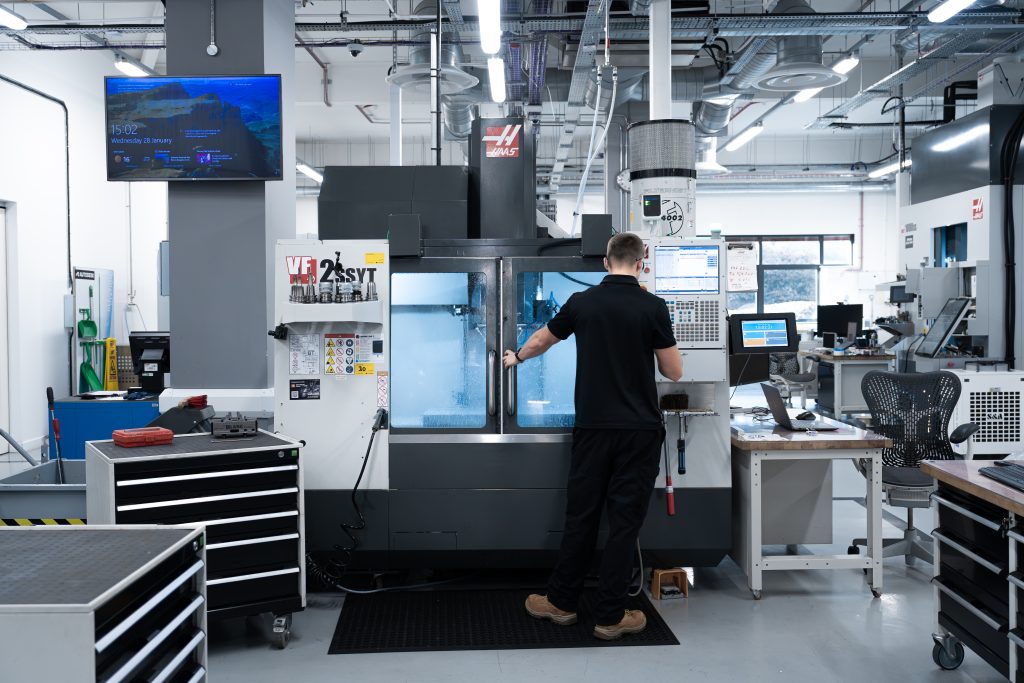
Within Autodesk, there are teams that not only build technology but also validate the software and capabilities. Nick Hill, Director of Technology Consulting at the Autodesk Birmingham Office, took a keen interest in digital twin technology. From its inception, they took it upon themselves to push the boundaries and advanced capabilities of Autodesk Tandem. Over the last two years, they have gone through a Scan-To-BIM-To-Twin process to develop their Tandem Twin and continue to explore and expand their aggregation of data. In doing so, they’ve identified five use cases that they now demonstrate to customers while simultaneously refining their own operational efficiency.
Monitoring machine availability: A precursor to overall equipment effectiveness
The Autodesk Birmingham Tech Center hosts many CNC machines, 3D printers and Robotic solutions . However, the purpose of this facility is for validation and R&D, rather than large-scale production. The team on-site still took a keen interest in measuring OEE (overall Equipment Effectiveness). Traditional OEE measures and calculates availability, production, and quality, with strict goals of improving efficiency. For the Birmingham team, Nick explained, “It’s about how well a piece of equipment is utilized, basically. So, how much idle time there is, and if you look at ours, there’s a lot of red, but we’re a research department.”
“How do you monitor, and how can you ensure that the operator hasn’t changed your machine parameters?” asked Nick. This question cuts to the heart of process control challenges in precision manufacturing. For Nick’s team, Tandem provided the answer. A way to continuously monitor machine parameters and track availability and performance data like spindle speeds and feedrate overrides. While they don’t monitor all components such as quality, this focused approach to OEE has proven invaluable for customers in industries like aerospace, where maintaining fixed processes and compliance isn’t optional, it’s mission-critical.
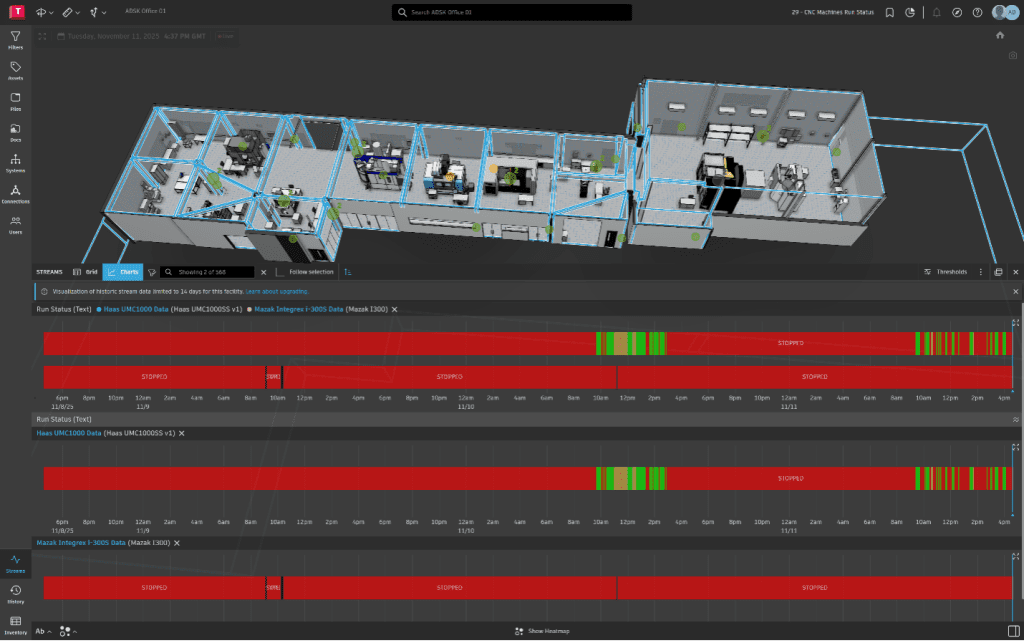
“If you hooked up your production line’s QA system, you can feed the pass/fail data directly into Tandem. Using something like Tandem Dashboard Beta, you can then calculate your OEE real-time.”
Donny Wong, Manufacturing Specialist, Autodesk
Savings and sustainable actions derived from power monitoring
“If it’s not measured and monitored, it’s not acted upon,” Nick proclaimed after describing how power monitoring data had revealed potential cost savings by reducing unnecessary machine operation. While not a production facility, the Birmingham Tech Center leaves its machines on all day long, allowing Autodesk employees from around the globe to access and connect those machines remotely. The Technology Centre has set an ambitious target to reduce energy consumption by improving equipment utilization over the coming months. Analysis of seven CNC machines over a four-week period (5 January–1 February) showed that while they consumed 12,715 kWh in total, approximately 8,510 kWh was used while the machines were idle. Addressing these idle periods by switching machines off when not in use can reduce energy consumption by up to 67%.
Leveraging Tandem, they were able to collect, visualize, and extract these insights about their idle machines, which in return could potentially be one of their solutions to the UK’s Energy Savings Opportunity Scheme (ESOS), helping them meet the program’s requirement to audit energy consumption and identify energy saving opportunities across their operations.
Expanding cost savings and sustainability to monitoring solar panels
“CNC machines are extremely power hungry. And so, reliance on the grid would rack up massive costs, whereas solar panels make a huge amount of sense here,” Donny explained how the Birmingham center cuts its electrical costs by relying on solar power. He continued to explain, “We monitor all of our solar panels, the amount of power produced per day, per year, the CO2 produced, the equivalent trees planted by having solar panels, and we can track that on a day-to-day basis.”
Using Autodesk Tandem, they are examining the amount of power they’re using per level in the building, and they’re able to compare it to the amount of power they’re producing with the solar panels, versus how much power their machines are using. He continued to say, “We can decide: do we actually need to incorporate more solar panels to help reduce the reliance on the grid? It ties into the whole reduction of operating costs in the long run.”
Leveraging both power and solar panel monitoring in Tandem will ultimately help operators make more cost-effective decisions across their overall operations. The next step is to create a dashboard showing power in vs. power out using Tandem Dashboards Beta, which will allow us to calculate net energy (power in minus power out) and understand grid reliance.
Leveraging the digital twin for health and safety monitoring
Beyond optimizing machine performance and energy consumption, the Birmingham Tech Center is leveraging its digital twin to create a comprehensive health and safety monitoring system. By integrating environmental and proximity sensors throughout the facility, they’re addressing regulatory compliance while gaining real-time visibility into conditions that affect both workers’ wellbeing and operational integrity.
Environmental Sensors
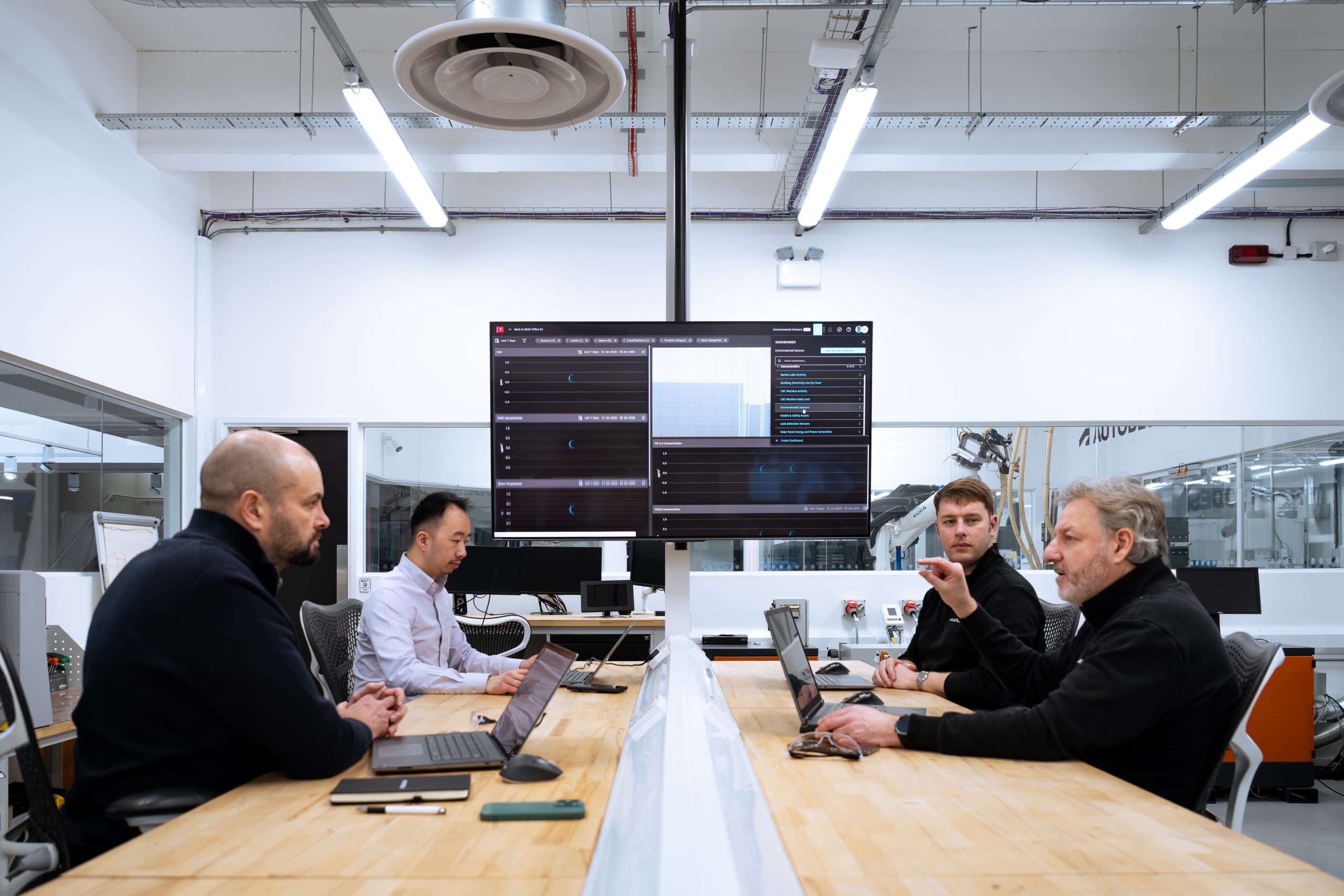
The workshop already has sensors for noise levels, CO2, humidity, light levels, particulate size, air pressure, temperature, and more. They’ve begun collecting the data and are beginning to understand it. Monitoring environmental conditions in CNC and industrial facilities is legally mandated under UK regulations, including the Health and Safety at Work Act 1974, COSHH, and Control of Noise at Work Regulations 2005, ensuring worker safety from hazards like hearing loss, respiratory disease, and heat stress. Beyond compliance, these measurements protect machine performance and provide evidence that safety controls are actively working.
Proximity sensors for safety monitoring
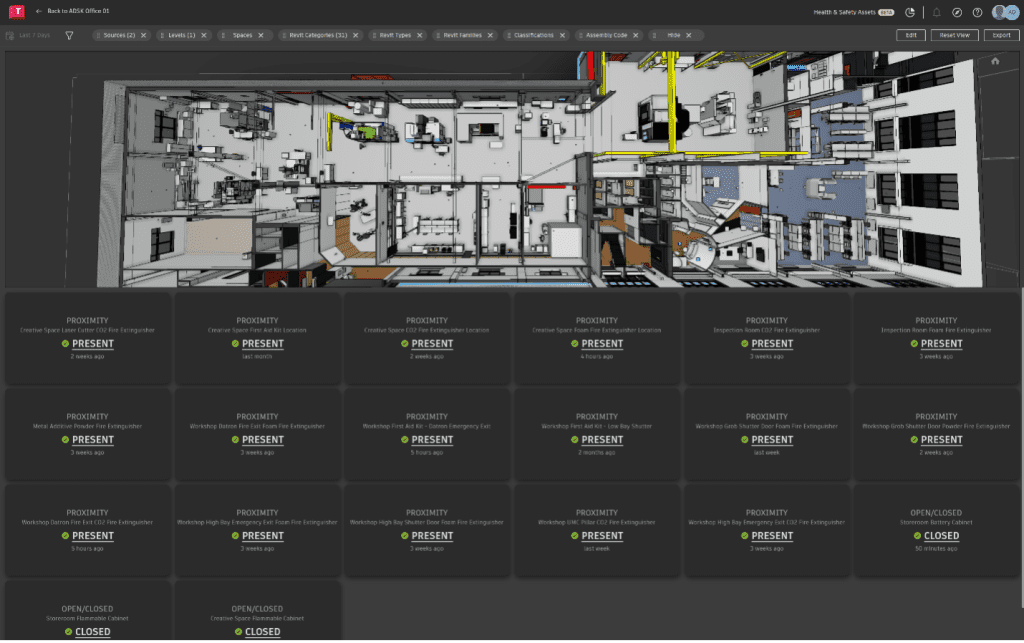
Fire Extinguishers, first aid kits, and flammable cabinets at the Birmingham Tech Center all had proximity sensors installed. This allows the team to visually see if a fire or safety item has been moved or opened, prompting the local team to take the appropriate response.
The team noted that while battery-life monitoring is helpful, it is not a complete failsafe, as the sensors also rely on a functioning network and supporting infrastructure. However, this capability significantly streamlines routine tasks for the facilities team—rather than manually checking every fire extinguisher, they are notified when and where attention is needed, including issues that arise between scheduled audits—making it a valuable tool alongside established safety protocol.
Monitoring in the digital twin
In Autodesk Tandem, this information is all aggregated and easily accessible to understand in context within the building and workshop. The data can be streamed as a heatmap and applied to spaces, elements, or specific systems, which users can play and visualize the data over time, or they can utilize charts with thresholds to see when a measurement is out of compliance. Additionally, the team can integrate other tools via Tandem Connect, and push notifications via text or CMMS systems, to create a workflow around alerts.
Data centricity and the ease of reports
“This shop manager must produce a weekly report outlining everything from sustainability to the parts produced/failed. It’s a comprehensive report outlining all activity in that workshop. He struggles to collect the data at the moment because it’s all displayed in separate Power BI dashboards. He wants to consolidate into one central source of truth and automate the report generation process. ” Donny explained about a recent interaction with a customer in Tandem, he continued to say, “In Autodesk Tandem we can make a dashboard that has all the data that they want, then we can say the dashboard is the report, because you can share the dashboard with their superiors to share that data.”
Using Tandem Connect, the Birmingham Tech Center can integrate many different data portals into one single source, and leveraging the new Dashboards beta feature, they’ve been able to compile that information using charts, gauges and more, generating a new kind of dashboard that can also provide content using the 3D model of the facility. This reduces weekly work by 10% for the shop manager, who now has all the access at their fingertips, and the dashboard already set up and saved.
The real value of Autodesk Tandem
“Autodesk Tandem brings all your systems together; that’s where you see Tandem’s power, it’s game-changing. It’s about making our lives easier; Tandem is helping us automate processes and connecting systems together, with the end goal of saving money and time.” -Donny Wong, Manufacturing Specialist
What the Birmingham Tech Center has accomplished internally is now helping Autodesk customers reimagine their own operations. By testing Tandem’s capabilities in a real-world manufacturing environment, the Birmingham Tech Centre team has developed five proven use cases that deliver insightful operations and address the exact challenges their customers face: fragmented data, hidden energy costs, compliance pressures, and time-consuming manual reporting. The digital twin isn’t just a technology platform, it’s becoming the operational backbone that brings manufacturing and facility management into alignment, delivering the unified visibility that modern operations demand.
More resources
Discover more articles, webinars, and whitepapers. Here are a few we think could be of interest.