Factory digital twins: recommended modeling practices for achieving scalability
Creating a factory digital twin isn’t just visualizing a facility in 3D. It’s about making it a data-driven operational model; one that combines geometry, asset data, and live IoT data into a single source of truth.
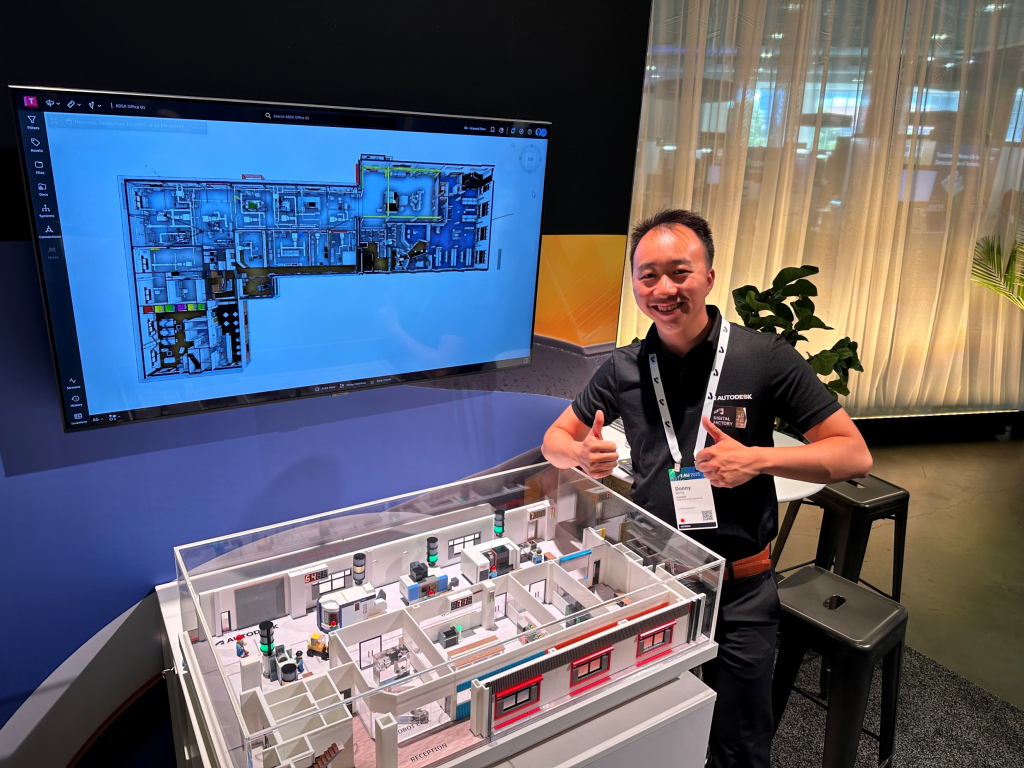
At the Birmingham Technology Centre (BTC), Autodesk’s manufacturing-focused R&D facility in the United Kingdom, the team has been developing a data-centric digital twin using Autodesk Tandem. Their experience of going from scan-to-BIM-to-twin provides clear guidance on what actually matters when modeling with a digital twin in mind, and where teams often overinvest.
This article outlines the lessons learned while building the digital twin of this existing facility. It also shares recommended modeling practices that could apply to similar projects.
1. Start with reality capture data, not assumptions
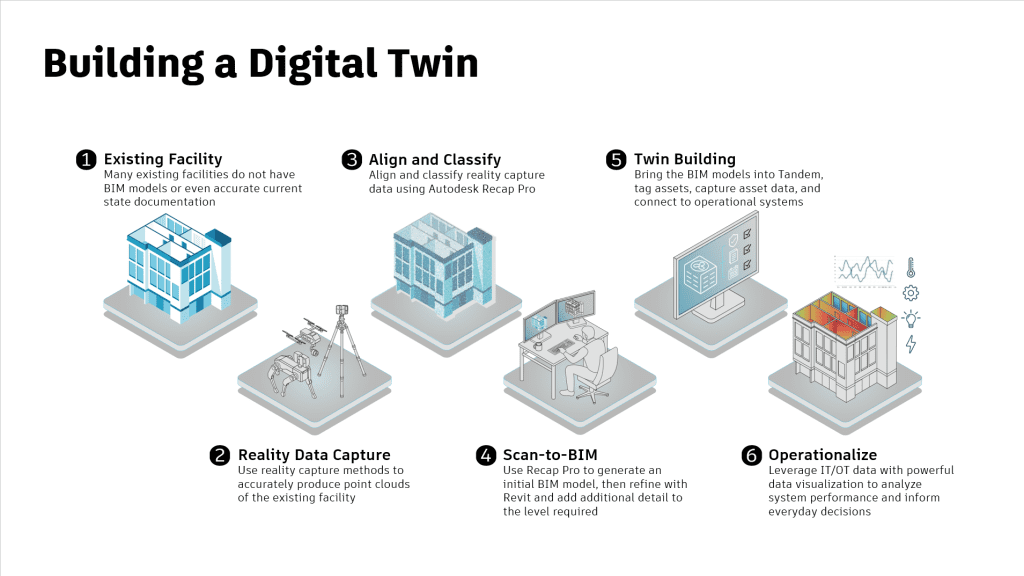
Legacy drawings are often outdated or poorly maintained. As such, when building a digital twin of an existing factory, if you want to achieve an accurate model, you should begin with reality data. At BTC, the team combined aerial drone surveys with mobile LiDAR scanning and terrestrial scanners to capture both accessible and hard-to-reach spaces.
The goal wasn’t just geometric accuracy, but to have confidence in spatial alignment across systems. “We had to really bring that data from old paper drawings into the 3D world,” Donny noted, emphasizing that point clouds became the foundation for everything that followed.
Reality capture quickly established as-built truth, ensuring the digital twin was built on the right information, without the need to repeatedly cross-check paper drawings. Control points were used to align scans, and one key lesson emerged: treat point clouds as modeling references, not final deliverables.
2. Be intentional about level of detail (LOD)
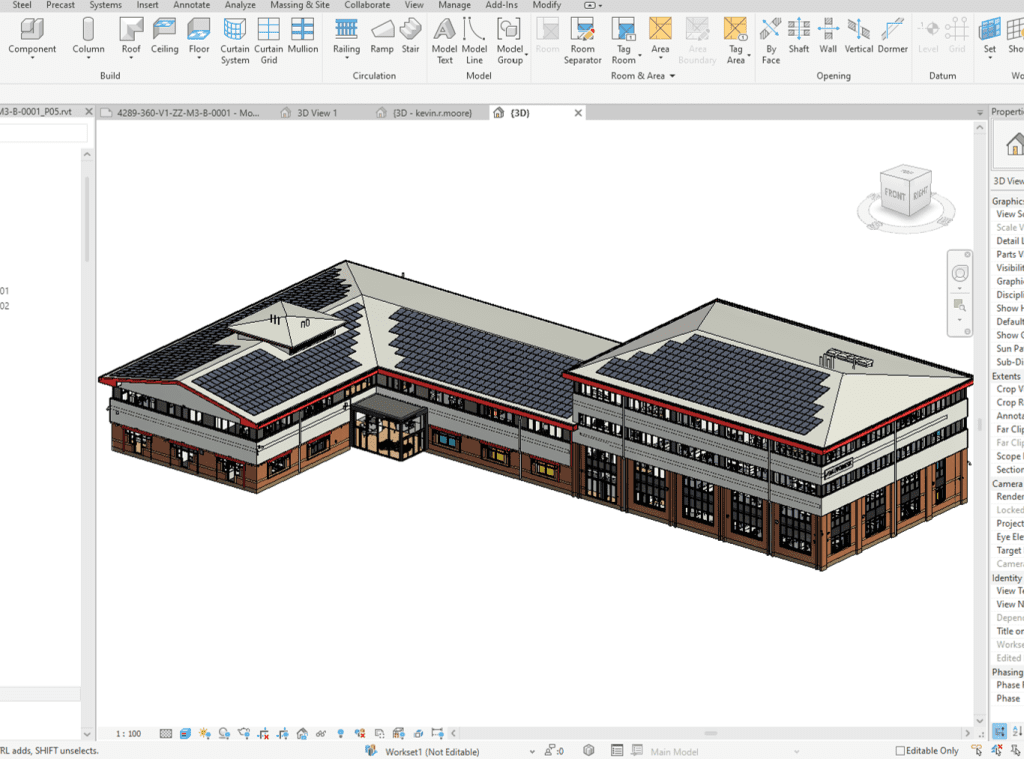
One of the most important lessons the BTC team learned was recognizing what didn’t need to be modeled. Initially, the team had a third-party create an LOD 300–400 Revit model of the entire facility. In hindsight, that level of detail was unnecessary outside of the workshop and machine areas. “Ultimately, we didn’t need that level of detail. You don’t need every single piece of furniture modeled,” Donny shared during the webinar.
Whether the digital twin is the deliverable for a new or existing facility, LOD requirements should be defined as early as possible. And higher LOD should only be applied where operational decisions depend on it.
Building the twin for factory maintenance purposes, rather than visual perfection, delivers the same operational experience while massively reducing the effort. In the BTC case, less than LOD 300 would have provided what the on-site team needed.
3. Classify assets correctly in Revit for factory digital twins
The intelligence of a factory digital twin depends heavily on asset classification during modeling. At BTC, machine types, capabilities, and categories were defined in Revit to ensure seamless integration with Tandem. Donny explained, “If you’ve properly classified assets in Revit, that data flows automatically into Tandem, which is a great workflow.”
Treating Revit parameters as operational metadata saves significant time downstream. This approach eliminates nearly all manual data re-entry and ensures consistency across systems.
4. Combine static geometry with near-real-time data streams
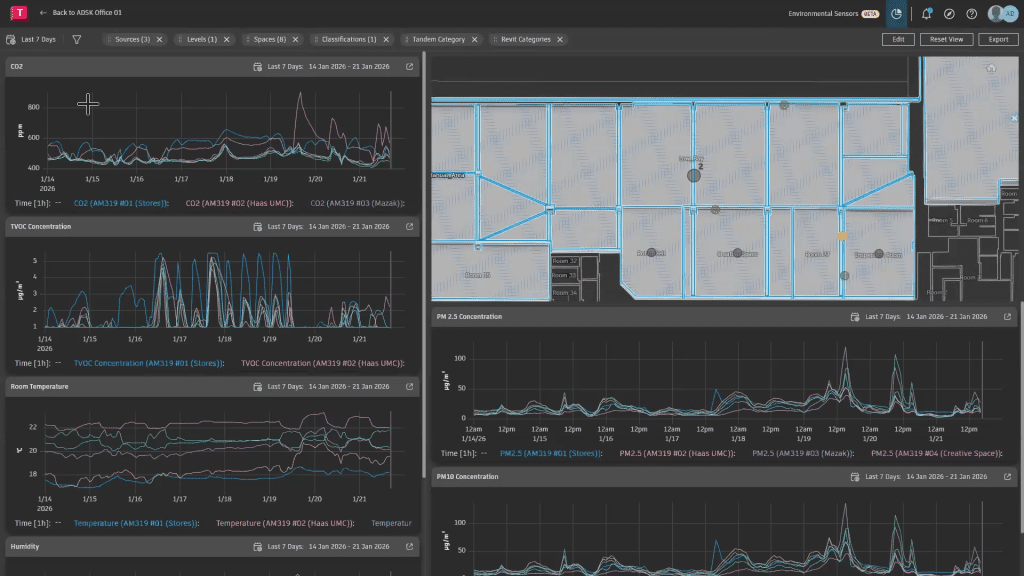
A descriptive twin (the first of five levels of digital twin maturity) is simply a descriptive model of the physical facility. In Tandem, you can take that model and transform it into an informative twin (level two). When near-real-time data is introduced and incorporated within the model, it will eventually become a predictive twin (level three).
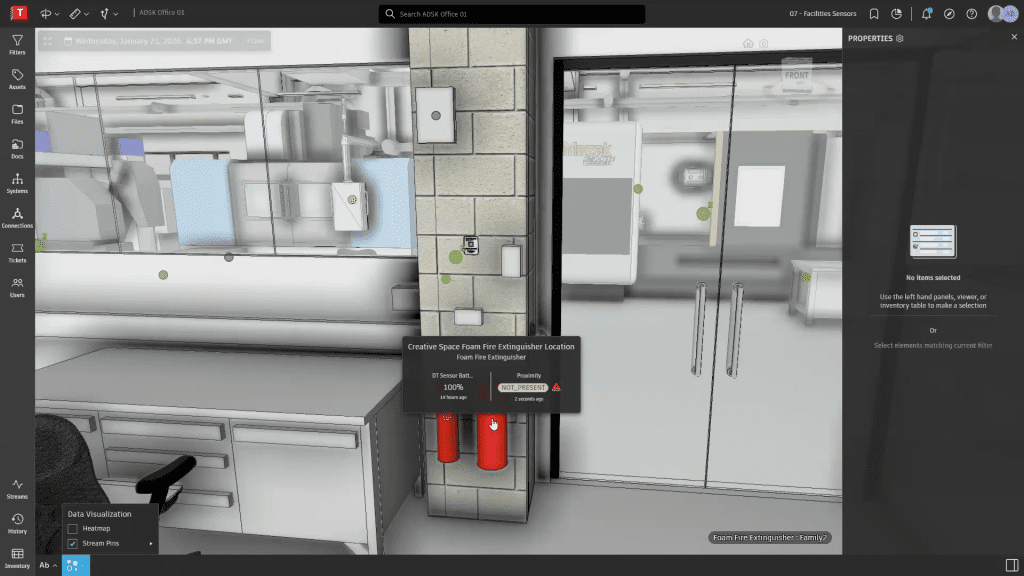
At BTC, the team connected CNC machines, power meters, environmental sensors, and safety devices using Tandem Connect and Autodesk APIs. “You have your static data, which is the geometry, and then you have livestream data, which tells you what’s happening in near real-time,” Donny said. The result is a centralized operational view spanning machines, spaces, sustainability metrics, and health and safety systems.
When modeling a digital twin, identifying the required static (or design) data and time-series (IoT) data early on is important. This will help determine what asset data is needed to normalize and validate streams, as well as any middleware that might be required. That is, design for near real-time insight, not control.
5. Model for factory use cases, not just visualization
BTC’s factory digital twin is used by operators, facility managers, and safety teams, not just BIM/VDC Specialists. Saved Views enable users to easily return to filtered views, helping these teams answer common questions, quickly. “It’s truly a multifunctional tool. Not only for people running the workshop, but also the facility or health and safety teams,” Donny explained.
The takeaway: modeling decisions should support how people will interrogate the twin, not just how it looks. So, align modeling scope with operational questions, and reactive and preventative tasks. This can be done with filtering, grouping, and dashboards. It’s also important to keep in mind design views for non-BIM users, as operation and project team members come from a variety of backgrounds.
6. Treat the factory digital twin as a living system
Perhaps the most important mindset shift is recognizing that a factory digital twin is never finished. “It’s not polished. It’s an ongoing project,” Donny said. “There’s a much bigger journey ahead of us.”
Machines change, sensors evolve or become obsolete, and use cases expand. Successful factory twins are designed to adapt. That’s why the process is repeatable in Autodesk Tandem.
Expect model updates over time. Keep geometry and data loosely coupled and plan for extensibility, not finality. Assigning responsibility to a person or team is key to ensuring the digital twin is updated regularly and continues to be a valued, living system.
Conclusion
Achieving a meaningful factory digital twin is less about maximum detail and more about intentional modeling, clean data structures, and real operational value. The Birmingham Technology Centre demonstrates that when modeling is driven by use cases and paired with live data, a digital twin becomes a powerful decision-making platform rather than just a descriptive 3D model. As Donny succinctly put it, “As long as you have an environment which is driven by data, our process is applicable.”
More resources
Discover more articles, webinars, and whitepapers. Here are a few we think could be of interest.