Tickets falling through the cracks
Why is building operations becoming more complex than ever?
In recent years, buildings have become significantly more complex to operate. Advances in building systems technology have increased the number of interconnected assets that facilities need to manage day-to-day, but these assets are often in separate, non-centralized systems. At the same time, new building regulations are coming into place, and occupants increasingly expect buildings to be safer, more sustainable, and more responsive to their needs.
These growing complexities come at a difficult time for operational teams. Many organizations are experiencing a shortage of experienced facilities professionals, driven by an ageing workforce, retirements, and a limited pipeline of new talent entering the industry. As a result, teams are being asked to manage more systems, more data, and higher expectations, often with fewer people and less knowledge.
This combination of operational complexity and labor constraints is putting sustained pressure on building operations teams. Nowhere is this more visible than in how maintenance tickets are managed. Preventive and reactive maintenance tickets are a critical tool for ensuring building performance, yet the information needed to act quickly and effectively is often fragmented across tools and systems.
Many teams rely on CMMS solutions to manage maintenance tasks and tickets. While these systems are essential, they often lack the broader context required to understand where an issue or a ticket is occurring within the facility and how it relates to surrounding assets, spaces and building systems, which is fundamental information when reactive tickets arise. As a result, operational teams spend valuable time switching between systems to locate problems, understand dependencies, and diagnose root causes. We frequently hear from teams that locating an issue or gathering enough context to act can take hours — time they simply do not have.
The same challenge exists for preventive maintenance. With limited resources, efficiency is vital. When operational teams plan preventive tasks, understanding which areas of a building can be grouped by proximity and asset relationships can significantly improve planning and execution. Additionally, knowing which assets are underperforming within their spatial context and associated systems- especially those with higher risk levels- can help optimize scheduling and streamline the planning of preventive maintenance activities.
When tickets lack clear location, context, and visibility, they are more likely to be delayed, duplicated, or missed altogether, causing them to fall through the cracks.
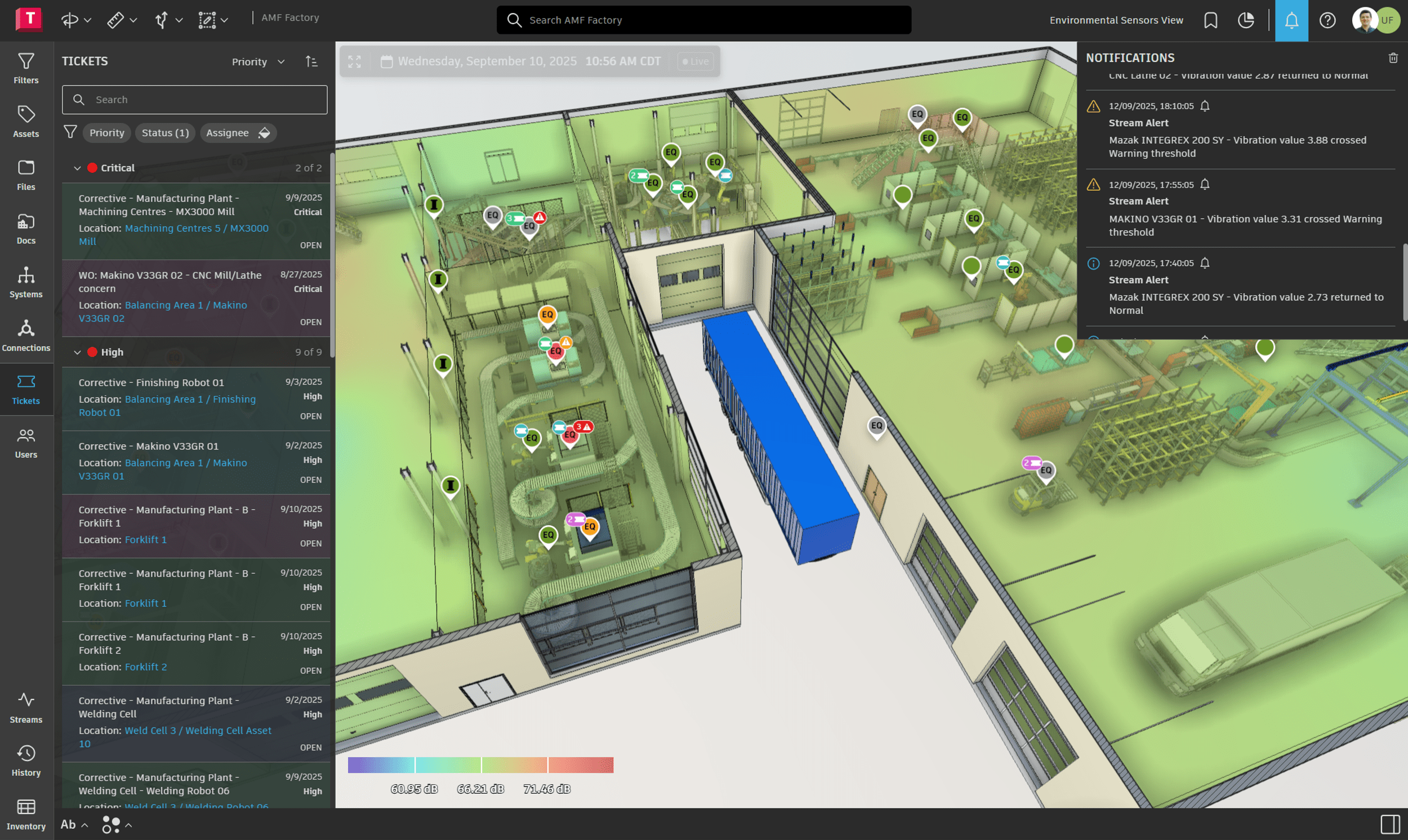
View Tickets in context of the 3D model and heatmapping
Providing teams with access to consolidated operational data, enriched with location and spatial context, helps them make faster and more informed decisions. By bringing together information from CMMS, BMS, IoT systems and linking it to the physical reality of the building, teams can better understand where attention is needed, prioritize work more effectively, and give technicians the context they need to resolve issues efficiently when they are on site. Without this connective layer, tickets remain isolated events rather than part of an operational picture. This is what Tandem is designed to address.
Tickets should not be isolated tasks that disappear across disconnected systems. With the Tandem tickets beta, you can connect CMMS tickets directly to your digital twin, giving your teams the location, asset context, and system relationships they need to act faster. The tickets beta is now available through our Insider Lounge.
Learn more here to explore how connecting tickets to spatial and operational context can help your team become more efficient.
More resources
Discover more articles, webinars, and whitepapers. Here are a few we think could be of interest.