Aptitude: From blueprint to breathing building
For decades, the construction industry’s approach to project handover followed a familiar pattern. Once construction was complete, owners received a collection of manuals, drawings, spreadsheets and documentation. The project team moved on, and facility operators were left to navigate the complexities of the building themselves.
That model may have worked when buildings were largely concrete, steel and mechanical systems. But today’s built environments are powered by interconnected networks of HVAC, electrical, security, occupancy, metering, IT, and operational technology systems that generate vast amounts of data every day.
For Aptitude, a technology integration company and subsidiary of JE Dunn Construction, the challenge was clear: if buildings have become living technology ecosystems, why do owners still receive handovers designed for a different era?
The answer led the company to Autodesk Tandem and a new vision for how digital twins can bridge the gap between construction and operations.
The handover problem no one solved
According to the Aptitude team, one of the biggest challenges in commercial construction occurs at the transition between project delivery and building operations.
By the time a large commercial building is completed, months or even years may have passed since the original conversations about owner goals and operational requirements. During that period, technologies evolve, priorities shift and dozens of contractors contribute systems that must ultimately work together.
The result is often an overwhelming collection of documentation fragmented across systems, folders and platforms. Traditional handover has become a world of “a dusty folder of manuals” in an era when buildings are increasingly data-driven.
Aptitude was established to address many of these coordination challenges. Born from recurring issues encountered by JE Dunn Construction, the company specializes in low-voltage systems integration and building technology coordination. Its role is to connect the stakeholders, platforms and systems that often fall between traditional project scopes. The company acts as “the contractor who builds what they sell,” ensuring critical information doesn’t get lost at lifecycle transition points.
Why digital twins became a business necessity
The growth of connected technologies has fundamentally changed what building owners expect from their facilities.
Ten years ago, technologies such as smart sensors, occupancy monitoring, indoor environmental monitoring and advanced metering were costly and relatively uncommon. Today, they’re becoming standard components of modern buildings.
And these days, owners are asking different questions. Instead of just wanting confirmation the building was delivered as specified, like they did five years ago, now they want to know:
- How efficiently is it operating?
- Are systems performing as intended?
- How healthy is the indoor environment?
- Where can operational costs be reduced?
- How can performance be measured and improved?
Answering those questions requires visibility into the building’s ongoing performance. Which is why digital twins have moved from being a future concept to operational necessity.
Turning BIM into a living operational platform
For Aptitude, the distinction between BIM and a digital twin is simple. A BIM model captures what was designed and built. A digital twin extends that model by connecting it to real-world operational data.
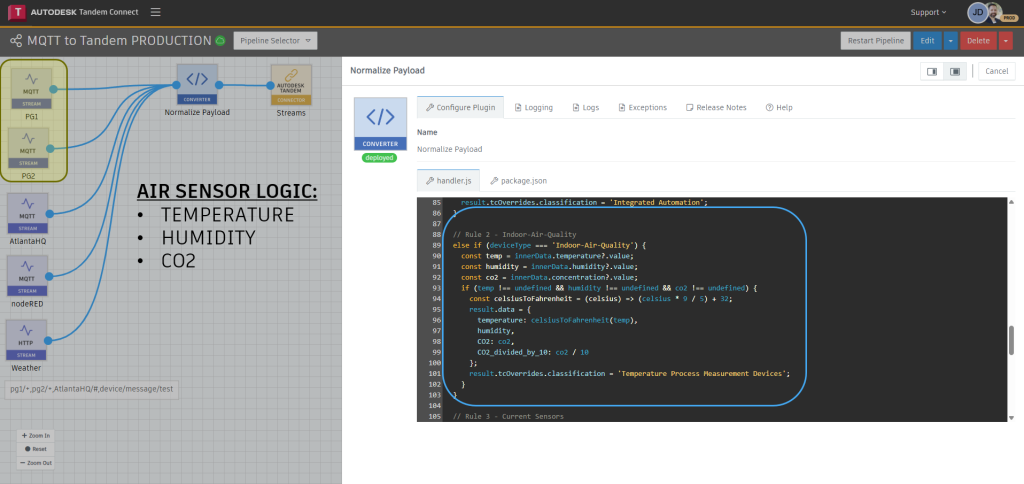
The company begins with the Revit models already created during design and construction. Rather than recreating information after handover, Aptitude validates the model data, develops a comprehensive asset registry and connects real-time operational information before publishing the environment into Autodesk Tandem.
The result is a “single source of truth” for the building. Instead of asset information being duplicated across drawings, equipment schedules, commissioning records, and maintenance systems, owners gain a connected environment where building information and operational performance exist within the same context. As a result, the building becomes easier to understand, easier to operate and easier to optimize.
Proving the value in its own building
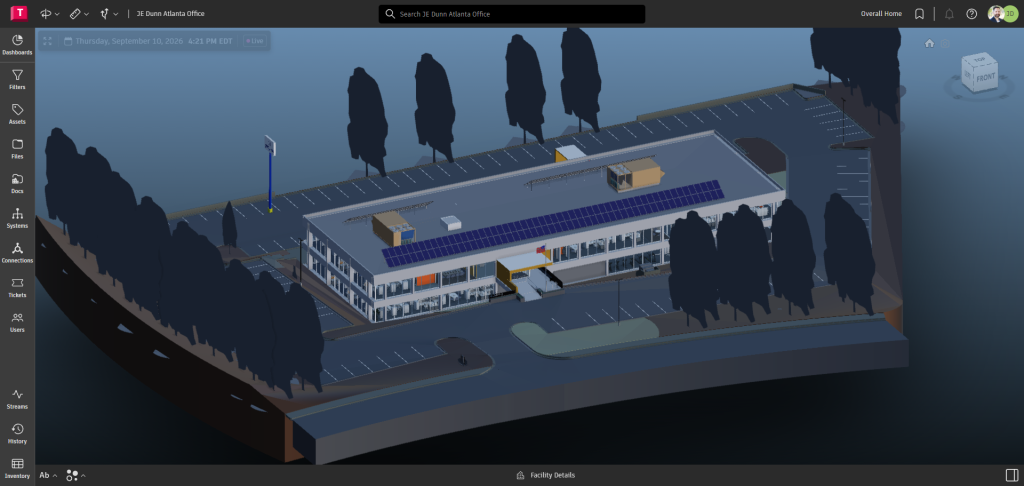
Before taking digital twin services to customers, Aptitude tested the approach internally. The company implemented Autodesk Tandem within the JE Dunn Atlanta office, creating a real-world environment to demonstrate how a connected digital twin could support daily operations. They soon uncovered plenty of evidence.
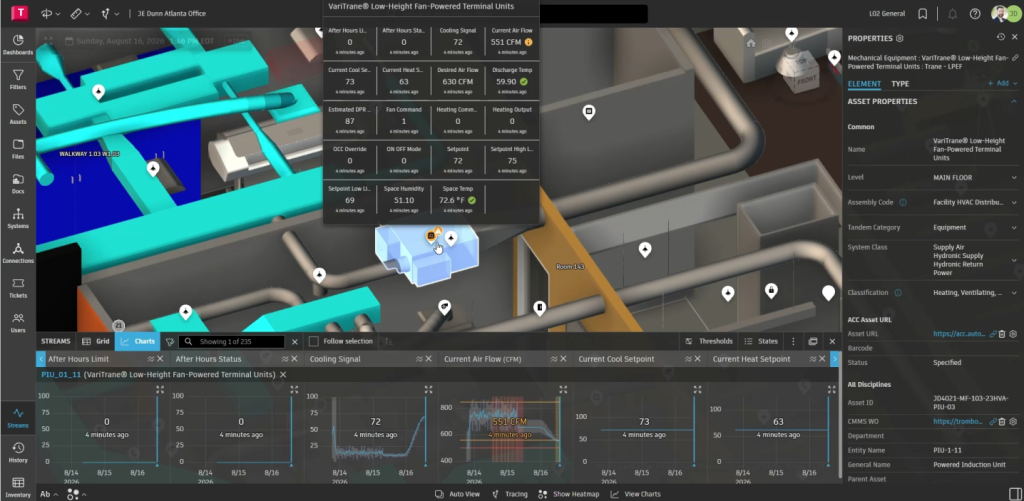
Over a weekend, a leak detection sensor identified a faulty ice-maker fitting and immediately generated an alert, which meant the issue was addressed before significant damage occurred. In another instance, the digital twin highlighted abnormal temperatures approaching 100ºF within a section of the building.
Further investigation revealed that HVAC controls had been programmed incorrectly, causing heating equipment to activate when cooling was needed. The problem was identified and corrected remotely.
The team also discovered rooftop mechanical units operating unnecessarily during weekends. By adjusting scheduling and control strategies, weekly energy consumption was reduced by approximately 50%, generating an estimated annual saving of more than $20,000.
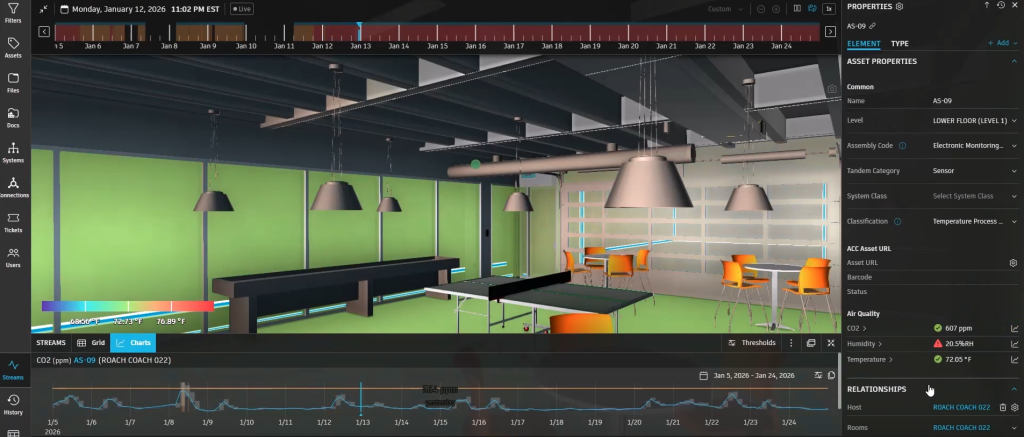
Indoor environmental monitoring delivered additional benefits. The building achieved RESET certification while collecting granular data on temperature, humidity and carbon dioxide levels, helping support occupant wellbeing, and operational performance.
For Aptitude, these examples demonstrated that a digital twin is not simply a visualization tool, but an operational platform that delivers measurable business outcomes.
A new model for the AEC industry
Traditionally, value creation in construction has largely ended when a project reaches completion. Digital twins create the potential for a longer-term relationship built around operational optimization, analytics, ongoing support, and lifecycle value.
Autodesk Tandem has become a key component of Aptitude’s growing digital buildings offering that helps owners better understand, operate and improve their facilities. Given they are already embedded within projects during design and construction, the company can leverage existing models, documentation, and project knowledge to accelerate digital twin deployment and deliver value faster.
The long-term vision is clear: move beyond project delivery and toward lifecycle delivery. As buildings become increasingly intelligent and interconnected, owners will need intuitive tools that transform complex operational data into actionable insights that can be easily and quickly digested. In Aptitude’s view, digital twins provide a powerful foundation for that future.
A modern building should be more than a completed project. It should be a living asset that continues to deliver value long after construction ends. For Aptitude, the goal is to take construction projects “from blueprint to breathing building.”
More resources
Discover more articles, webinars, and whitepapers. Here are a few we think could be of interest.