How digital twins are modernizing airport operations and passenger throughput
An airport’s revenue, reputation, and resilience all depend on one thing; smooth and consistent passenger throughput. The plethora of challenges that the terminal operations teams must navigate to ensure this happens, is a complicated maze of logistics.
From check-in and security to baggage handling and airfield lighting, critical systems power every part of the passenger journey. When any of these systems fail, the impact is rarely confined. It creates a ripple effect that can spread across the entire airport.
In a complex airport ecosystem, automation reduces human bottlenecks. Instead of waiting for escalation, systems can automatically trigger vendor notifications, adjust equipment settings, and initiate work orders.
What are the biggest operational challenges facing airports today?
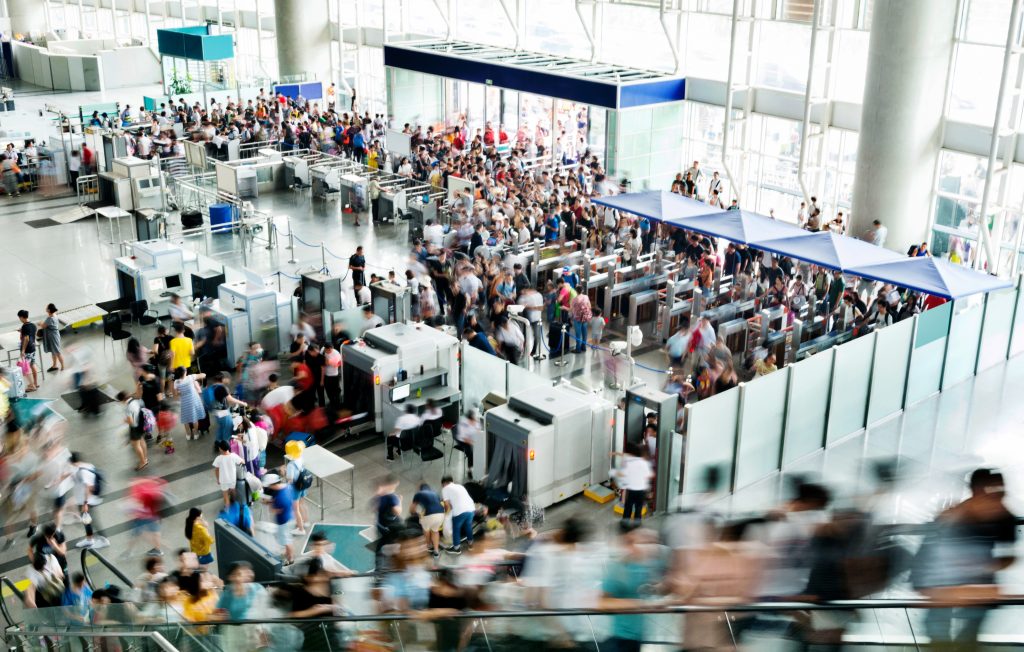
We regularly speak to aviation industry experts to understand what the day-to-day operational challenges look like, and there are some clear, recurring themes. Airports rely on a vast number of highly specialized assets. Many of which operate 24/7. Yet ownership is often fragmented. So too are the teams and their data. Human and mechanical errors are inevitable, and unfortunately, this leads to a lot of reactive maintenance and crisis management. Stress is felt by all, from facility teams, to crews, to passengers.
“A digital twin creates a shared platform, so teams can optimize the whole airport, not just their own silo.”
Robert Bray, Vice President of Autodesk
How can digital twins ease the pressures of airport operations?
Ultimately, the goal is to create a frictionless journey for passengers, from the moment they enter the airport to the moment they take off. To achieve this, terminal operations teams need to be able to identify and resolve issues before they impact customers.
1. Fragmented data becomes connected, shared insights
Airports generate massive amounts of data across dozens of intertwined systems, but that information often lives in silos. A digital twin changes that by connecting automated processes and their data into a single, near-real-time view of the airport that every department can access and understand in context.
Instead of each team optimizing only its own area, a shared digital model enables more holistic decision-making. As Robert Bray, Vice President of Autodesk Tandem, puts it, “A digital twin creates a shared platform, so teams can optimize the whole airport, not just their own silo.”
Visualization plays a key role in making that shared understanding possible. Tim Kelly, Director of Product Strategy at Autodesk, explains that “Being able to visualize all this information in one place is critical. A model aligns everyone’s understanding far faster than documents or dashboards alone.”
Importantly, the goal isn’t to replace existing systems but to connect them in a meaningful way. Lewis Watts, Principal Global Business Development at Autodesk, explains that Tandem “isn’t trying to be a CMMS or an IoT device manager,” but rather a way to “centralize decision-making and cross-system alerts.”
That clarity helps airport teams focus on what matters most in the moment. As Kelly summarizes, “knowing where to put your attention, which areas to address and when, is what improves the passenger experience. A digital twin surfaces the information you need to act quickly.”
By connecting fragmented systems into a centralized, visual operating environment, Autodesk Tandem enables airports to move from siloed decision-making to coordinated, campus-wide optimization. Instead of reacting to isolated alerts, teams gain shared visibility into how assets, utilities, passenger flow, and tenant spaces interact in real time. The result is faster issue resolution, better cross-department collaboration, reduced operational risk, and more informed decisions that protect throughput, revenue, and passenger experience. That shared visibility is the foundation for more proactive operations.
2. From crisis management to preventative and predictive maintenance
Digital twins enable a shift away from that pattern by supporting preventative and predictive maintenance.
“Most airports are still responding to failures after they happen,” says Rad Lazic, Technical Sales Specialist at Autodesk. “Digital twins enable a shift to predictive maintenance, fixing the one thing before it disrupts the whole terminal operations.”
That shift is especially critical in environments that operate nonstop. As Bray notes, “Digital twins shift airports from reacting to failures to preventing them.”
Closing runways or shutting down baggage systems is not only expensive, but incredibly complex, often requiring weeks or months of planning. Without reliable data, it’s difficult to fully understand the downstream impact of these disruptions.
With Autodesk Tandem’s insights, it’s easier to plan for these eventualities. Essentially, digital twins can visualize the current state and predict the impact of various scenarios.
“Digital twins enable a shift to predictive maintenance, fixing the one thing before it disrupts the whole terminal operations.”
Rad Lazic, Technical Sales Specialist at Autodesk
3. Fewer manual interventions, more automated resolutions
What’s on the horizon for digital twin technology is even more exciting. Predictive twins will forecast and help operational leaders prioritize preventative maintenance. But soon, these twins will become semi-autonomous. As Watts explains, “Where we’re heading is moving from advising what to do, to actually actioning it, automatically calling service agents, triggering maintenance, and adjusting systems.”
4. Passengers are happier—and they’re spending more
By optimizing the passenger experience, you can directly drive additional revenue. Digital twin technology, like Autodesk Tandem, can help you optimize the monetization of your retail spaces. Watts believes, “Digital twins shouldn’t just be facility tools, they should be operational control centres. For instance, if airports can accurately tell passengers when baggage will arrive, they won’t stand frustrated at the carousel, they’ll go and buy a coffee.”
Similarly, with the footfall data that Autodesk Tandem centralizes within the full 3D context, terminal operations teams have greater visibility of how valuable each retail space really is. Watts explains, “The value of retail space isn’t its size, it’s how prominent it is. How many feet fall past that space should determine its value. When you can prove higher footfall past critical areas, you can charge more for this retail space.”
When airports have real-time visibility into passenger movement, queue lengths, baggage timelines, and retail traffic patterns, they can turn operational insight into commercial advantage. Digital twins help airports align passenger flow with concession strategy, optimize space valuation, and reduce friction points that discourage spending. The result is not just a better experience, it is measurable growth in non-aeronautical revenue driven by data-backed operational intelligence.
Build airport resiliency with digital twin insights
Autodesk Tandem helps airports move toward more proactive, data-driven decisions. By connecting systems, predicting disruptions, and enabling faster responses, digital twins have the power to improve throughput, reduce network-wide stress, and help build more resilient airport ecosystems.
See how Denver International Airport is leveraging Autodesk Tandem to modernize operations here.
More resources
Discover more articles, webinars, and whitepapers. Here are a few we think could be of interest.