How PEC is transforming project delivery with Autodesk Tandem
How would a completely digitized project delivery change your team’s day-to-day operations for the better?
Responsible for designing everything from hospitals to wind turbines, Professional Engineering Consultants (PEC) is a multidisciplinary engineering firm on a mission—to fully digitize project delivery. The data behind every PEC project is vast and complex. In the past, this meant siloed datasets, repetitive data entry, and time-consuming processes. As project complexity grew, so did the workload—until the team began exploring digital twin technology with Autodesk Tandem.

The impact was immediate: work that once required days of effort now fits into a single morning, removing tedious tasks and creating an environment where the team can focus on purposeful, project-driving work.
We spoke with three of PEC’s changemakers—Don VenJohn, Bobby Goldsberry, and Mason Lumley—about how they’re rethinking workflows to eliminate inefficiencies, streamline collaboration, and deliver greater value to clients. Their goal goes beyond adopting new tools, it’s about building a culture where technology empowers people. By reducing repetitive work and creating more meaningful roles, they’re enabling both colleagues and clients to operate with greater clarity and confidence.
“We want to lead the way and energize the industry,” said Bobby Goldsberry, VDC Manager at PEC. “There are real challenges—disconnected data, inefficiencies, and the constant push to do more with less. What we’re doing is about finding better ways to work, so the benefits aren’t just for us, but for our clients and partners.”
From building stronger relationships with future-focused general contractors to delivering higher-value handovers that ensure facility owners are operational-ready from day one, PEC sees digital twins as the future of collaborative project delivery.
Creating one source of truth
Senior VDC Specialist Don VenJohn recalled when PEC’s deliverable process was “fragmented into multiple locations.” With project data scattered across different systems, managing, validating, and transferring information to facility owners was slow and cumbersome. Static-file handovers—spreadsheets and folders of documents—often created inefficiencies and delays.
The reason is simple: when assets arrive in separate files, owners and facility managers must dig through each to find what they need—costing time and money.
“Now, we take the project to about 40% completion after design, and the GC enriches the digital twin with subcontractor data,” Don explained. “If they only deliver a spreadsheet and documents, it costs the owner more.”
These results are only possible with the right partners. A GC who shares PEC’s vision for digital twins ensures subcontractor data is added during commissioning—making the process streamlined and cost-effective.
“If we can provide a single source of truth, we’re not just delivering data—we’re building trust and strengthening relationships,” Don said. “With a digital twin, we’re reducing project costs and delivering long-term value.”
Housing all project data in one place not only streamlines today’s workflows—it also lays the foundation for AI-powered facility management. Using ACC BIM data and Microsoft Copilot, Software Developer Mason Lumley has built a model that lets owners ask plain-language questions—for example, “When does the HVAC warranty on floor four expire?”—and get instant, accurate answers that are always up to date. This ensures critical information is no longer buried in files or reliant on one person’s knowledge—it’s accessible to anyone, anytime.
Efficiently building data-rich models of facilities
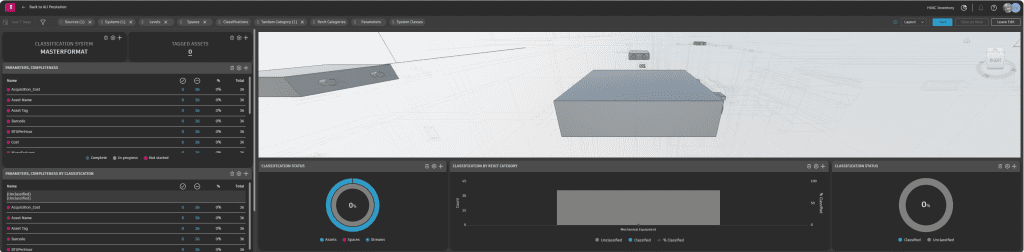
As PEC’s team became more familiar with Autodesk’s digital twin solution, they uncovered powerful features and built custom connections to further streamline workflows. Two tools in particular—Tandem’s Facility Templates and Autodesk Construction Cloud’s (ACC) Build Templates—have transformed how they deliver projects.
“With Tandem and the ACC Assets tool in Build, I can create a template once and roll it out across multiple projects without starting from scratch,” said Don. “Now that these templates are in place, what used to be a manual, repetitive process is fully automated—and done in just three minutes.”
One clear example is a standard government submittal to the Corps of Engineers—a task that once took about four days. Using Tandem, Don cut that time to a few hours. Now, with the new templates, he can finish it in under an hour.
The team pushed this even further by creating a custom connection from the ACC Build Parameter Service that automatically pulls assets from the catalog into Revit—or directly into Tandem. By matching the digital twin’s parameters exactly, subcontractor data integrates seamlessly, and Don can run quality control inside the same data-rich 3D model—catching and correcting issues without extra steps or duplicate work.
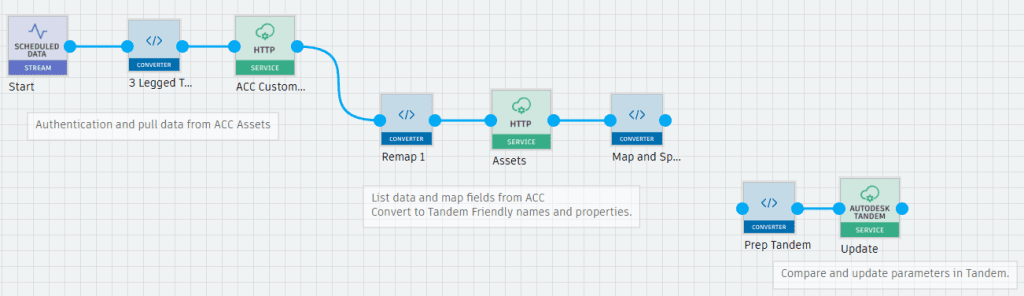
Connecting ACC data to the Tandem digital twins
From the outset, Don, Bobby, and Mason saw Tandem’s potential to connect seamlessly with Autodesk Construction Cloud. “We chose Tandem because it’s already part of the ACC design ecosystem. So, it fits seamlessly into our existing workflows.” Don explained.
For Mason, the integration potential is just the start. “With tools like Tandem Connect building those ACC connections, there’s no telling where it could go in the future.”
Tandem Connect is a low-code integration tool that links near-real-time project data to an owner’s existing systems—without the need for custom backend development. Mason has built plenty of integrations from scratch, but he chooses Tandem Connect for speed and simplicity. “If I had to integrate Tandem with ACC manually, it would take me five to ten times longer than using Tandem Connect,” he explained.
Once the ACC connection is in place, transferring data between systems is nearly effortless. “If you’ve done it before, it’s a five-minute task—just drag, drop, and type in a couple of details,” Mason said.
This efficiency marks a major shift. Mapping data between systems was once a tedious, manual process. Now, assets collected in Autodesk Build—the field solution for capturing data during construction—flow directly into the live digital twin, giving owners verified, field-accurate data instantly.
Realizing Tandem’s digital twin capabilities—together
Working with Tandem has strengthened collaboration between project stakeholders, resulting in higher-value deliverables and owners ready for operations on day one.
“We meet with partners and owners to show them what’s possible—that’s been key to our development process,” Don said. Opening these conversations ensures the digital twins they create solve real-world challenges for both the AEC industry and facility managers.
This two-way dialogue often sparks new possibilities. Owners still return with questions like, “Could it do this?” or “Would it help us with that?”
For Bobby, the relationships are just as valuable as the technology. “We want to be seen as the innovative engineering group. We want to connect with building users and contractors—even when we don’t have a contract with them.”
PEC knows digital twin adoption will be driven by all parties. While owner requests are growing, engineering firms, designers, and contractors must work together to raise awareness and make digital twins a standard deliverable. Beyond being an additional revenue stream, they are a long-term, high-value asset for owners.
“We want to do the right thing—not just because we’re contractually obligated,” Bobby said.
Standardizing the process, simplifying the output
Even though awareness of digital twins is still developing among PEC’s customers and partners, the team is committed to making them the standard.
“I’m confident this is the process the general contractor will use,” Don said. Moving forward, PEC plans to deliver digital twins instead of folders filled with static files. “If they still want an Excel file, they can generate that themselves.”
And PEC is thinking far beyond project handover. Don posed the question: “What about a year from now, when the facility team starts looking for information?” In the old model, that search often ends in frustration. “As soon as you deliver it, it’s outdated. It’s a dead data flow.”
By contrast, a digital twin is live, active, and always in one place—providing near-real-time facility data whenever it’s needed. “As a live, active model, how much time does that save? It just keeps paying dividends to use a digital twin,” Don said.
Are you ready to modernize operations? Try Autodesk Tandem for free now.
More resources
Discover more articles, webinars, and whitepapers. Here are a few we think could be of interest.